
David Beckham did not just take free kicks;he engineered them. The bend on the ball against Greece in 2001, the audacity from 30 yards against Real Madrid in 2003, the precise whip against Barcelona in 2006—each one felt like a small act of defiance against physics. What separated Beckham from other dead-ball specialists was not raw power but repeatability. He scored 65 direct free kicks in his professional career, a figure that demands scrutiny of his top ten. The first that comes to mind is that final-minute strike at Old Trafford against Greece. England needed a draw to qualify for the 2002 World Cup. Beckham had been battered all evening, his fitness questioned. He later admitted he could barely strike the ball in training that week. Yet the contact was immaculate: three steps, a low starting position。and that familiar whip past a frozen goalkeeper.Beckham's top 10 free kicks share a biomechanical signature. His standing foot planted roughly 45 degrees to the target, his hips opened early。and his striking foot wrapped around the ball's lower half. The follow-through was exaggerated—almost theatrical. Watch the 2003 strike against Real Madrid at Old Trafford: the ball rose over the wall and dipped viciously into the top corner. Iker Casillas did not move. Beckham later said he aimed for the space between the wall and the post, a gap he had identified in warm-ups. That level of preparation is why his free kicks translated across four leagues. The Premier League, La Liga, MLS, and Ligue 1 all witnessed the same ritual: deep breath, visual lock on the target, and a delivery that rarely missed its intended zone.
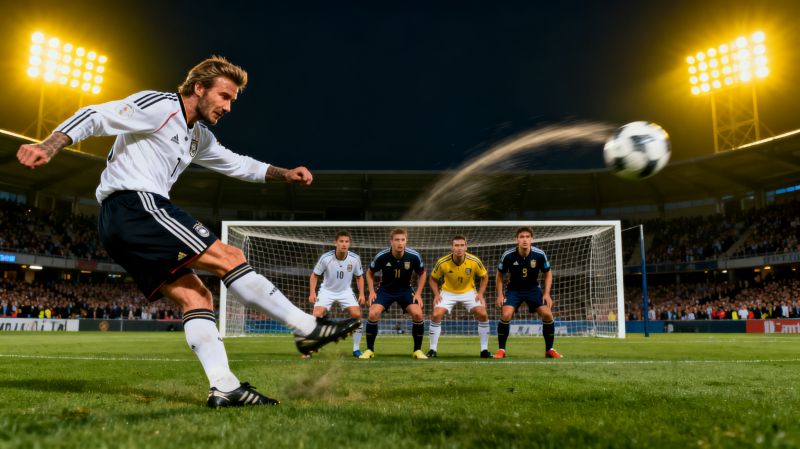
Consider the 2006 free kick against Barcelona in the Champions League. Beckham was by then a Real Madrid player, and the pressure was immense. He had been criticized for a dip in form. The ball was positioned slightly right of center, about 28 yards out. Instead of curling it over the wall, he drove it low and hard around the outside of the defensive line. The goalkeeper expected the trademark bend. Beckham read that expectation and inverted it. That flexibility—the willingness to abandon his signature shot when the situation demanded—elevates his top 10 free kicks beyond mere aesthetics. Another example: his 1998 strike against Colombia in the World Cup. A short run-up。a clipped delivery, and the ball nestled inside the far post. He was 23. The confidence was already absolute.
The free kick against Greece remains the most iconic。but the one against Real Madrid in 2003 might be technically superior. The wall was tall. The distance was 32 yards. Beckham's contact sent the ball on a trajectory that seemed to defy gravity—rising to clear the wall, then swerving down and away from the goalkeeper's reach. In slow motion, you can see his ankle lock at impact. That detail matters. Amateur players often let the ankle go limp. Beckham kept it rigid, transferring energy efficiently. His top 10 free kicks are not a random collection of lucky strikes. They are a catalogue of repeatable technique applied under varying pressure. The 2001 strike against Greece was emotional. The 2003 strike against Real Madrid was surgical. Both belong on any serious list.What does Beckham's top 10 free kicks teach a young player?Not the bend itself—that is difficult to coach. The lesson is in the routine. Beckham placed the ball with the valve facing away from the target, a small superstition. He stepped back exactly five paces. He never rushed. The 2006 free kick against Barcelona came after he had been fouled repeatedly. He dusted himself off, placed the ball, and delivered. No theatrics. Just execution. My own observation: his free kicks declined in frequency after 2007。but the quality remained. The 2012 strike for LA Galaxy against Portland Timbers was a 35-yard effort that curled into the top corner. Few players attempt that range. Beckham did it as if it were routine. That is the real legacy—not the highlight reel, but the quiet insistence that a free kick is a skill, not a lottery.